
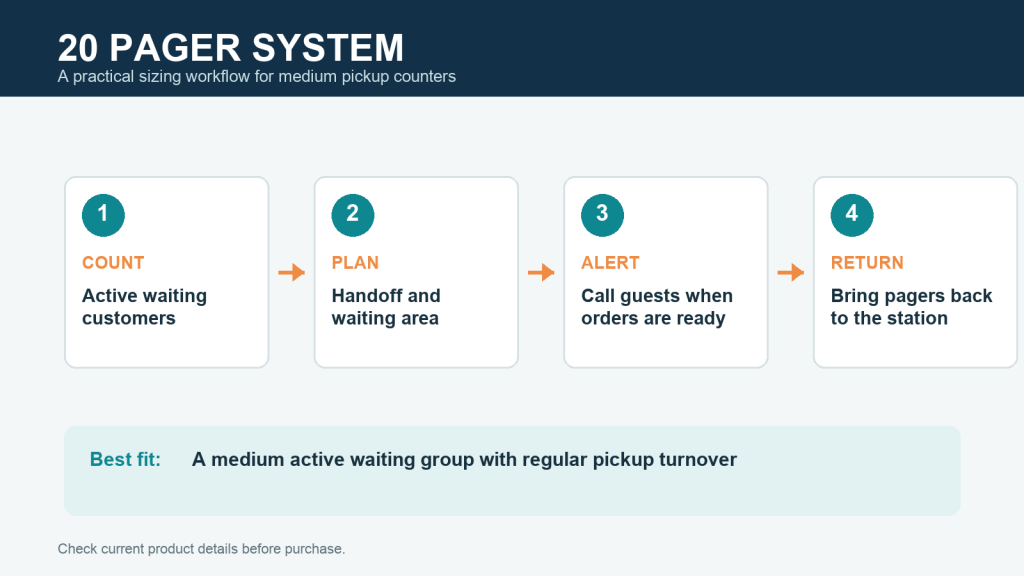
A 20 pager system can be a practical middle option for a restaurant, cafe, dessert shop, or service counter that regularly has more waiting guests than a small kit can handle but does not need the largest available set. The right choice depends on active waiting demand and the way pagers move through your counter workflow.
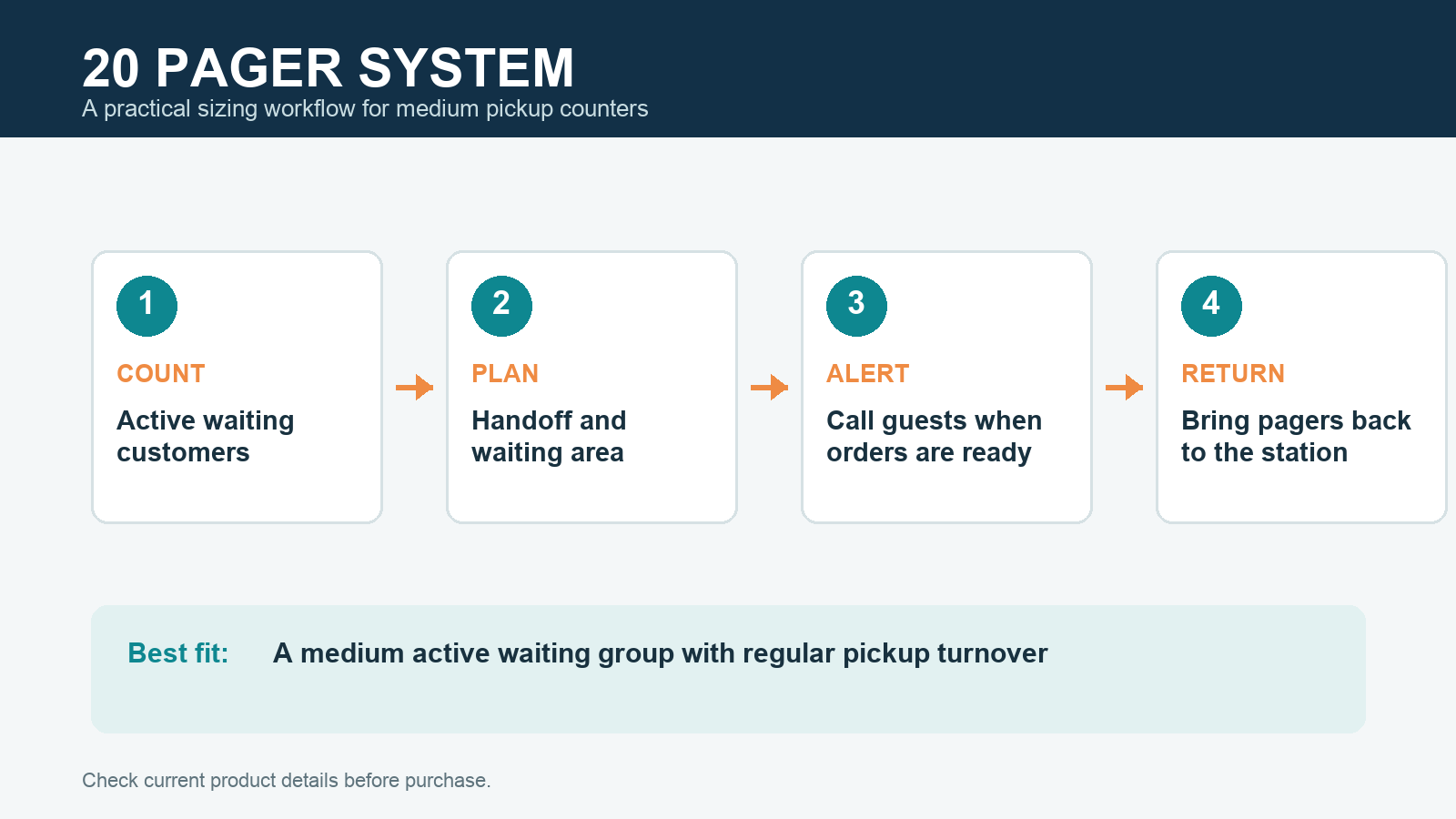
When a 20 pager system is a good fit
Consider a 20 pager system when your normal busy period creates a steady group of waiting customers at the same time. This is common at counter-service restaurants, cafes, bakeries, food halls, and customer service desks where visitors can wait nearby instead of standing at the pickup point.
Start with the highest normal active waiting count, then add room for pagers still away from the charging base. This simple check is more useful than choosing a kit from daily order volume alone. Daily orders can be high while the active waiting group stays small, or modest while a short rush creates a crowded counter.
20 pagers compared with other common kit sizes
| Observed waiting pattern | Guide to review | Selection reason |
|---|---|---|
| Usually only a few active waits | 10 pager system | Keeps the counter setup compact when demand is consistently light. |
| Small counter with regular pickup waves | 16 pager system | Provides a modest buffer for ordinary meal-period waiting. |
| Medium waiting group with repeated turnover | 20 pager system | Balances additional capacity with a manageable station footprint. |
| Large rush or slower pager return cycle | 24 pager system | Adds more buffer when active waits often rise higher. |
Questions to answer before you buy
1. How many customers wait at the same time?
Observe a normal busy period and record the highest number of pagers handed out before the first group returns. Use normal operating conditions rather than a one-off event.
2. Where will customers wait?
Mark the waiting area, pickup counter, entrance, and any shared seating zone. A clear waiting location makes the handoff easier to explain and helps staff know where alerted customers will return.
3. How will pagers come back?
Decide whether customers return pagers to the counter, a tray, or another visible handoff point. The return step matters because a pager that is not back at the station cannot be issued to the next waiting customer.
4. What should staff say?
Use a short instruction: keep the pager with you, wait in the marked area, and return when your order is ready. Consistent wording reduces repeated explanations during the rush.
20 pager system buying checklist
- Measure the highest normal active waiting count.
- Allow for pagers that have not yet returned.
- Confirm where the transmitter and charging base can sit.
- Plan a visible pager handout and return point.
- Ask about the exact features and included components for the kit you are considering.
- Do not assume range, battery runtime, certifications, warranty terms, or stock status without checking the current product information.
See the full STMITE options
Use the STMITE shop to review available paging products, then compare the restaurant pager system and guest paging system pages for different service flows. For a layout-specific recommendation, contact STMITE with your active waiting count and counter setup.
FAQ
Is a 20 pager system suitable for a small restaurant?
It can be, if a short busy period regularly creates a medium-sized active waiting group. Count simultaneous waits first instead of judging by floor area alone.
Should I choose 16 or 20 pagers?
Review the 16 pager option when your active waiting count stays comfortably below the kit capacity. Review 20 pagers when you need more room for peak turnover or unreturned pagers.
Is 20 pagers always better than a smaller kit?
No. A larger kit is useful only when its added capacity matches the workflow. If the active waiting count is low, a smaller setup may be easier to place and manage.
Bottom line
A 20 pager system is a sensible option when a counter needs more capacity than a small kit but wants to keep the station controlled. Count active waits, plan the return cycle, compare current STMITE product information, and contact the team when the layout needs a closer review.